
Two days and two protests involving students in Republika Srpska (RS) clearly illustrate who is allowed to speak their mind and who is not.
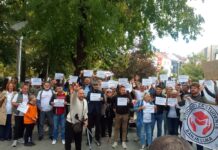
On October 11, police in Banja Luka rejected a request from the representatives of the Student Movement in Banja Luka to hold a public gathering. The event was not allowed to go ahead on the grounds that it could cause public disturbance and disrupt public order and peace. Police informed the students that they could not guarantee their safety.
Eight days earlier, at a gathering of students in Novi Pazar, Serbia, two banners had been displayed, among others, reading: “Srebrenica is genocide” and “Ratko Mladić is a war criminal.” This prompted a wave of reactions from tabloids, anonymous online portals without an impressum, public figures and influencers. The loudest response came from Republika Srpska. Messages soon appeared on the balconies of student dormitories: “Our generals are not war criminals” and “Republika Srpska is not genocidal. You have betrayed us.”
No official in Novi Pazar or anywhere else had ever claimed that Serbia or Republika Srpska was genocidal. Nevertheless, two banners in Novi Pazar were enough to prompt a student assembly in East Sarajevo on October 15.
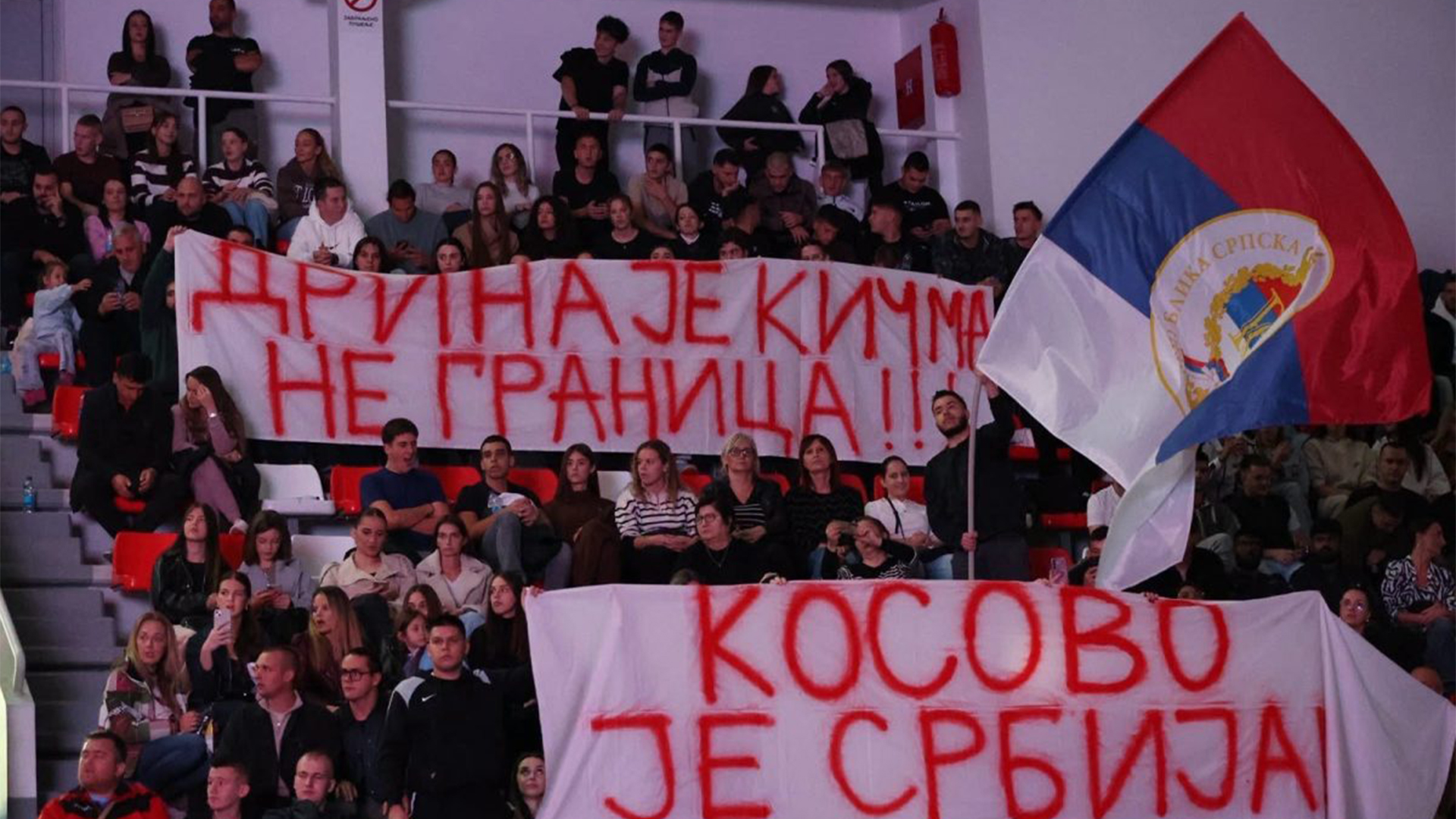
According to information obtained by Perspektiva, the event was organized with students being warned that they would face penalties if they failed to attend. With the support of the ruling Alliance of Independent Social Democrats (SNSD), transportation was arranged from other cities. Fewer than 300 students attended. According to an anonymous source, the turnout was insignificant.
Nikola Lapčević, president of the RS Student Union, spoke on behalf of the students he represents: “At first, we supported our colleagues in Serbia, believing in student solidarity and mutual respect. It was precisely because of that trust that we saw the controversial messages as a betrayal of the support we had offered, by those who displayed them, endorsed them or failed to disavow them.”
Media reports said that the RS Student Union and the Student Parliament of the University of East Sarajevo had agreed on further steps to organize the student assembly. The stated aim was to emphasize the importance of respecting the views of the majority of students and their collective position. The gathering’s main message was: “The Drina is a backbone, not a border.”
But Nenad Đorđić, secretary of the Student Union, told Perspektiva Plus a very different story.
“I consider this course of action deeply unfair to our colleagues in Banja Luka. It would have been natural and expected for our colleagues in East Sarajevo to consult us beforehand, so that, if an official position was needed, we could discuss the situation together and try to reach a common stance. Nevertheless, I want to emphasize once again that, in my personal opinion, the Student Union should not have taken a position on this issue at all. I believe that the political activities of students in Serbia, as well as their participation in elections and public gatherings, should not be subject to our approval or condemnation. Our role is to represent the interests of students in Republika Srpska, not to take sides in political conflicts that are not directly related to our work.”
It is unacceptable, Đorđić warns, to present any position as the official stance of an entire organization without first consulting all its representatives. Critical thinking, he says, is one of the most important qualities of an educated and responsible person and is essential to decision-making, particularly on sensitive issues. Unfortunately, he adds, in a society where critical examination of reality is often lacking, students are not always an exception.
“I believe it is particularly dangerous when serious opinions and decisions are formed on the basis of unverified information, sensationalist headlines and reporting by tabloids or other obscure media outlets, whose aim is often to fuel divisions, intolerance and the basest human instincts. Students, as future drivers of social development, are expected to be the very people who recognize, question and reject such practices. If we, as an academic community, fail to nurture freedom of thought, reasoned debate and responsibility for what we say in public, we can hardly expect the rest of society to do so,” Đorđić says.
At a meeting urgently convened by the president of the RS Student Union with the Student Parliament of the University of East Sarajevo, personal opinions were once again presented as speaking for students as a whole.
According to a source known to the editorial team who wishes to remain anonymous, students in Banja Luka and Foča boycotted the gathering, partly because it had not been officially organized by the entire Student Union.
“Students in Banja Luka and Foča don’t want to publicly boycott the gathering because there is an unwritten rule that student parliaments mind their own business, even when they belong to the same organization,” says an anonymous source from Banja Luka who spoke to Perspektiva.
On several occasions, representatives of the RS Student Union and the Student Parliament have met and held conferences with student parliaments from Serbia. According to an anonymous source from East Sarajevo who spoke to Perspektiva, those student representatives from Belgrade and Novi Sad are openly activists or members of the Serbian Progressive Party (SNS).
“I believe this was planned in advance. As I see it, this is, in a way, an attempt to mobilize students and demonstrate that students from Republika Srpska oppose the student protests, all because of the banners in Novi Pazar. The day before the gathering, student representatives came to our lectures and literally told us that we had to attend or those who didn’t would face sanctions. From what I can see, turnout is poor. I live near the sports hall where the gathering is taking place. Only three buses came from Pale, which is insignificant considering that there are around 500 students in the dormitory there alone, let alone the total number of students at the two public universities. They didn’t say what the sanctions would be, and I felt uncomfortable asking. But I can see that 99 percent of the people in my year didn’t go,” the anonymous source from East Sarajevo tells us.
Although pressure is being applied to portray the gathering as critically important, with claims that something bad will happen to all students in Republika Srpska if they fail to attend, that is actually a reflection of the organizers’ own fear, the anonymous source says.
“They are afraid that, if the gathering turns into a fiasco, they will personally be held accountable by the very people who gave them the idea to organize the assembly,” the source says.
Banja Luka students announced another gathering for Monday, October 19. But the police banned that one, too.
Those in power won’t let it happen.
Author: Ljupko Mišeljić